A maintenance worker begins servicing a high-voltage motor. The machine appears shut down. But without verification, assumptions become liabilities. That’s where a tag out index sheet enters—quiet, unassuming, and potentially lifesaving.
This document isn’t just paperwork. It’s a real-time ledger of control, tracking who locked or tagged a piece of equipment, when, and why. In environments governed by OSHA’s lockout/tagout (LOTO) standards, the tag out index sheet acts as the central nervous system of energy control. Mismanage it, and you risk serious injury. Master it, and you protect people, productivity, and compliance.
The Role of the Tag Out Index Sheet in LOTO Procedures
Lockout/tagout isn’t just about slapping a tag on a switch. It’s a systematic process to isolate hazardous energy sources—electrical, mechanical, hydraulic, pneumatic, chemical, thermal—during servicing or maintenance.
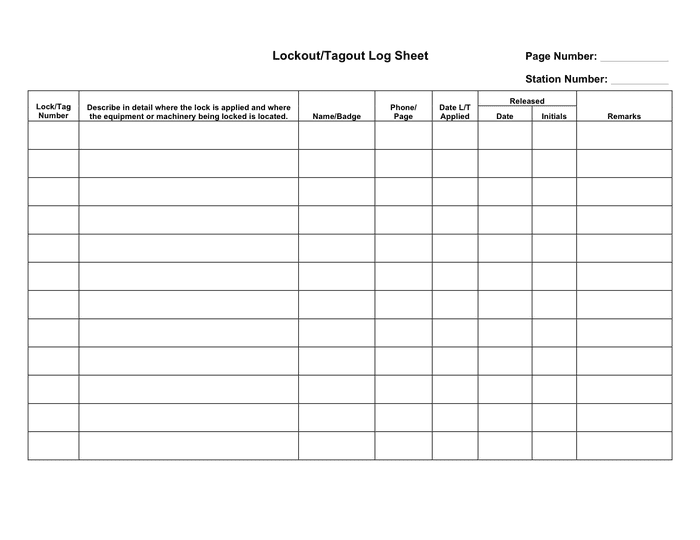
Within this system, the tag out index sheet serves as the master log. It records:
- Equipment name and ID
- Type of energy isolated
- Name and contact of the authorized employee
- Time and date of lock/tag application
- Reason for isolation
- Clearance status
Unlike individual lockout tags, which are affixed directly to energy-isolating devices, the index sheet is typically posted in a central location—like a control room or maintenance desk—where it’s visible to supervisors, maintenance crews, and safety officers.
Without this centralized record, multiple teams could unknowingly interfere with ongoing work. Imagine two crews servicing the same conveyor system on different shifts. If the first crew removes their lock but fails to update the index, the second crew might assume the system is safe—when in fact, residual energy remains uncontrolled.
When and Where the Tag Out Index Sheet Is Required
OSHA 29 CFR 1910.147 doesn’t explicitly mandate an index sheet for every LOTO event. But it does require procedures that ensure:
- Each authorized employee applies their own lock or tag
- All employees are informed of energy control procedures
- A method exists to verify that equipment is isolated before work begins
In multi-employee or complex operations, an index sheet is the most practical way to meet these requirements.
Common use cases include:
- Power plants – where dozens of isolations may occur simultaneously across turbines, transformers, and feedwater systems
- Manufacturing facilities – particularly on assembly lines with overlapping maintenance schedules
- Chemical processing units – where residual pressure or toxic substances pose extreme risks
- HVAC and utility systems – in large buildings or campuses where centralized control is essential
In contrast, single-person, short-duration tasks (e.g., replacing a fuse) might not require a full index sheet. But the moment multiple workers, shifts, or complex systems are involved, the index becomes non-negotiable.
Key Components of an Effective Tag Out Index Sheet
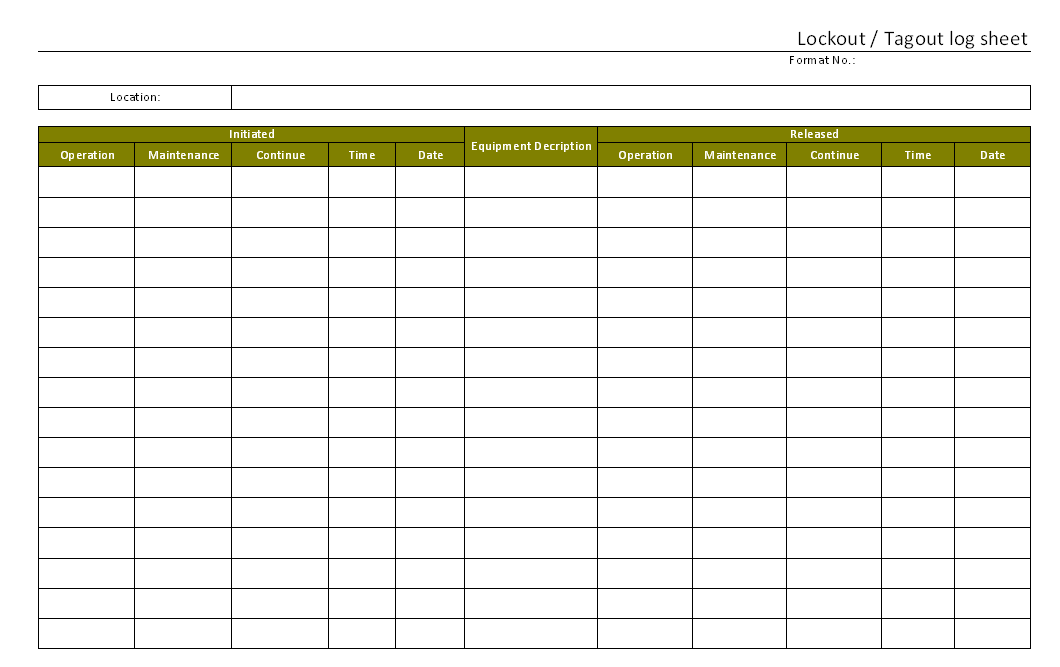
A poorly designed index sheet is worse than useless—it creates false confidence. An effective one contains clear, standardized, and enforceable data fields.
Essential Elements to Include
| Field | Purpose |
|---|---|
| Equipment ID | Unambiguous identification (e.g., PUMP-214-B) |
| Location | Physical area (e.g., Boiler Room, Level 3) |
| Energy Type | Electrical, hydraulic, etc. |
| Authorized Employee | Full name and department |
| Lock/Tag Number | Unique identifier matching physical device |
| Date & Time Applied | Timestamp of isolation |
| Work Description | Brief scope (e.g., “Replace motor bearings”) |
| Clearance Status | Open/Closed/Verified |
| Supervisor Approval | Signature or initials |
Some facilities use color-coded sheets per shift or department. Others integrate barcodes or QR codes that link to digital LOTO logs. The format matters less than consistency and accessibility.
A common mistake? Using vague descriptions like “maintenance in progress.” That tells no one what’s actually being done or which energy source is isolated. Specificity prevents miscommunication.
Common Mistakes That Undermine the Index Sheet’s Effectiveness
Even well-designed systems fail when human factors aren’t accounted for. These mistakes erode trust in the index sheet—and in the entire LOTO program.
1. Delayed Updates Technicians remove locks but forget to sign off on the index. The system shows active tags that no longer exist, leading to unnecessary downtime or, worse, false clearance.
2. Illegible Handwriting “John D.” becomes “Jon P.” or worse—unrecognizable. Use printed names or digital logs.
3. Missing Equipment IDs Writing “the big compressor” instead of “COMP-005” invites confusion, especially in facilities with multiple units.
4. No Verification Step Supervisors assume the sheet is accurate without cross-checking physical locks. Always conduct a field walkdown before re-energizing.
5. Offline-Only Systems Paper-based index sheets can be lost, damaged, or inaccessible during emergencies. Digital backups or cloud-based systems add resilience.
These errors aren’t just procedural—they’re cultural. They signal a gap between policy and practice. Fixing them requires training, auditing, and accountability.
Digital vs. Paper-Based Index Sheets: Practical Trade-Offs
The shift toward digital LOTO systems has sparked debate: are electronic tag out index sheets better than paper?
The answer depends on scale, risk, and infrastructure.
Paper-Based Systems: Pros and Cons
Pros: - No software or training required - Works during power outages - Simple for small teams
Cons: - Prone to damage or loss - Difficult to search or archive - Hard to audit remotely
Digital Systems: Pros and Cons
Pros: - Real-time updates across teams - Audit trails and automatic logs - Integration with CMMS (Computerized Maintenance Management Systems) - Alerts for overdue clearances
Cons: - Requires devices and connectivity - Initial setup cost - Risk of system failure or cybersecurity threats
For most mid-to-large industrial operations, hybrid models work best: physical tags and locks backed by a digital index. This ensures redundancy—when one system fails, the other holds.
Best Practices for Managing Tag Out Index Sheets
A tag out index sheet is only as strong as the process behind it. These practices strengthen reliability.
1. Assign Ownership Designate a LOTO coordinator responsible for maintaining and auditing the index daily.
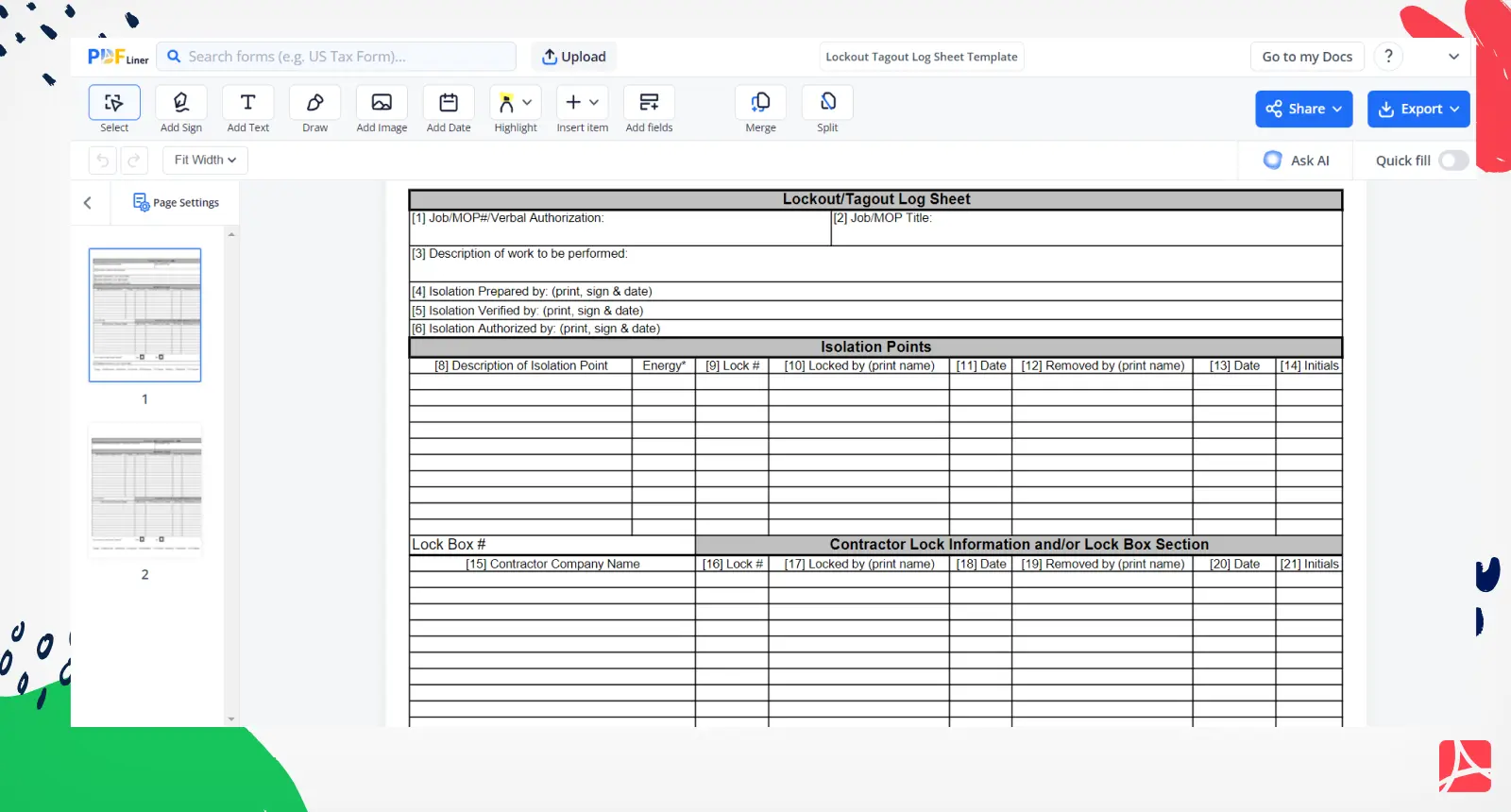
2. Standardize Forms Use uniform templates across all departments. Include your company logo, OSHA reference, and emergency contacts.
3. Train Regularly Conduct quarterly drills where employees simulate LOTO scenarios using the index sheet. Test both application and clearance phases.
4. Integrate with Shift Handovers Include index review as part of shift交接 (handover) protocols. The incoming team must verify all active tags before starting work.
5. Audit and Correct Perform random audits—compare the index to physical locks. Document discrepancies and address root causes.
One facility reduced LOTO violations by 78% simply by adding a 5-minute index review to their pre-shift meetings. Small habits create large safety margins.
Real-World Example: Preventing a Near-Miss with Proper Indexing
At a Midwest food processing plant, a mechanic began disassembling a packaging line. The line was tagged out, but the index sheet listed only one lock—his own. During disassembly, he noticed a second lock on the main disconnect.
He stopped work immediately.
Cross-referencing the lock number with the index revealed a mismatch: the second lock belonged to a technician from the night shift, whose entry had been omitted from the sheet. The technician had left early due to illness and forgot to update the log.
Because the index was being actively monitored, the error was caught before re-energization. The oversight could have led to a catastrophic startup during maintenance.
This incident underscores a critical truth: the tag out index sheet isn’t just about compliance. It’s a living safety tool that only works when treated with discipline.
How to Implement a Tag Out Index Sheet System
Starting from scratch? Follow this roadmap:
- Assess Your Needs
- Audit equipment, energy types, and maintenance frequency. Identify high-risk systems.
- Design the Template
- Use the essential elements listed earlier. Test it with frontline workers for clarity.
- Train Authorized Employees
- Focus on real-world scenarios. Emphasize personal accountability.
- Pilot in One Area
- Launch in a single department. Gather feedback and refine.
- Scale and Audit
- Roll out company-wide. Schedule monthly audits and annual reviews.
Include the index sheet in your written LOTO program—required under OSHA 1910.147(c). Treat it not as an add-on, but as a core control.
A tag out index sheet is more than a checklist. It’s a commitment to transparency, accountability, and safety. In high-risk environments, where seconds matter and mistakes cost lives, it’s the quiet guardian of order.
Implement it correctly—standardized, visible, and verified—and it becomes one of the most powerful tools in your safety arsenal.
Don’t wait for an incident to validate its importance. Start today: review your current LOTO process, locate your index sheet (or create one), and ensure every tag has a traceable story.
Your team’s safety depends on what you document—not just what you assume.
Frequently Asked Questions
What is the difference between a tag out index sheet and a lockout tag? A lockout tag is a physical label attached to an energy-isolating device, warning others not to operate it. The tag out index sheet is a centralized log that tracks all tags and locks across a facility.
Who is responsible for maintaining the index sheet? Typically, a designated LOTO coordinator or maintenance supervisor ensures the sheet is accurate, updated, and accessible.
Can digital systems replace paper index sheets? Yes, if they provide real-time tracking, user authentication, and backup capabilities. However, many facilities use both for redundancy.
Is a tag out index sheet required by OSHA? While not explicitly required, OSHA mandates procedures that ensure control of hazardous energy—using an index sheet is the most effective way to comply in multi-employee settings.
How long should completed index sheets be kept? Retain them for at least one year for audit and incident investigation purposes.
What should you do if the index sheet doesn’t match physical tags? Stop all operations. Investigate the discrepancy. Never re-energize equipment until all tags are accounted for and removed by their owners.
Can temporary workers apply tags to the index sheet? Only authorized employees trained in LOTO procedures can apply locks or tags. Temporary workers must undergo the same training before participation.
FAQ
What should you look for in What Is a Tag Out Index Sheet and How to Use It Effectively? Focus on relevance, practical value, and how well the solution matches real user intent.
Is What Is a Tag Out Index Sheet and How to Use It Effectively suitable for beginners? That depends on the workflow, but a clear step-by-step approach usually makes it easier to start.
How do you compare options around What Is a Tag Out Index Sheet and How to Use It Effectively? Compare features, trust signals, limitations, pricing, and ease of implementation.
What mistakes should you avoid? Avoid generic choices, weak validation, and decisions based only on marketing claims.
What is the next best step? Shortlist the most relevant options, validate them quickly, and refine from real-world results.